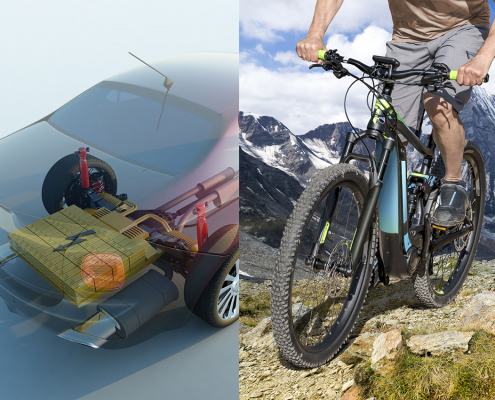
Ultrasonic wire bonding is one of the most flexible and beneficial joining techniques in the packaging of integrated circuits and in the production of battery packs.
Exemplary for battery packs wire bonding enables the electrical connection of cells to each other, to busbars, to a battery management board (BMB) / battery management system (BMS) or for voltage sensing. The steps in the manufacturing process of battery modules and packs require stable processes and a continous process and quality monitoring. A high level of automation ensures reliable and low resistance connections. This is the genuine field of ultrasonic wedge-wedge bonding.
Generally speaking, the industry distinguishes between fine and heavy wire bonding. As wire sizes from 15 μm to 650 μm can be processed, it has a wide field of application in the sector of volume production but especially in globally scaling mass production of semiconductor and sensor products.
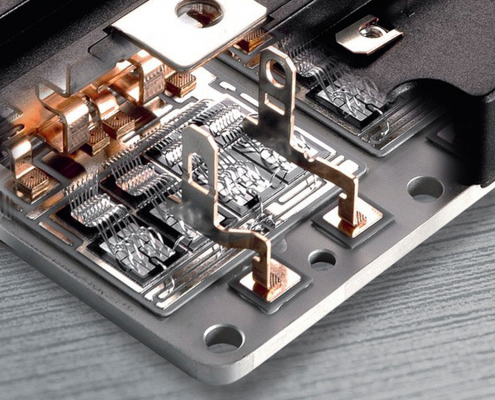
While fine wire (<100 μm) is processed for low current purposes (such as camera chips, sensors or high frequency applications), heavy wire’s (≥100 μm) domain is more on batteries and power applications like inverters, switching devices or control units. Components which are processed with fine wires from 12,5-75µm are found in RF technology, COB, MCM, hybrids, optical and automotive electronics. The power applications typically use 75 μm up to 650 μm aluminum wire, but also copper wire or ribbon can be processed.
Each wire has at least two bond locations – the first bond (source) and the second bond (destination). For reasons it is possible that one wire uses more bonds – this is a chain or stitch bond. The wire or ribbon forms a loop between the bond locations and can compensate thermomechanical stress.
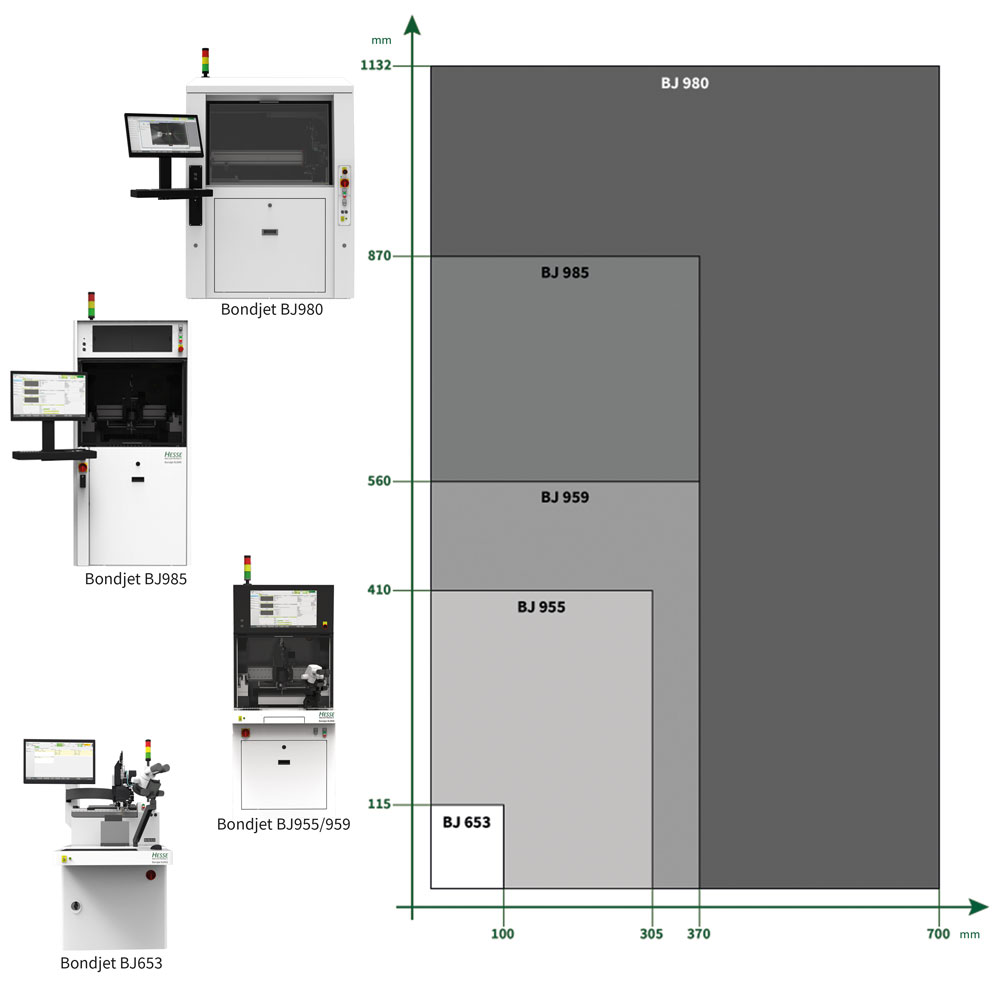
Wire Bonders of Hesse offer maximum flexibility with working areas from 100 x 115 mm up to 700 x 1132 mm for the battery connections and power modules of small or large sized units.
Bondjet BJ653 Bondjet BJ955/959/BJ985
Hence wire bonding is well known in any industry manufacturing electronic devices. Here are some examples from chosen sectors:
Power Semiconductor:
Traction (Railways), Wind Mills, Solar, Inductive Heating, Motor Controls
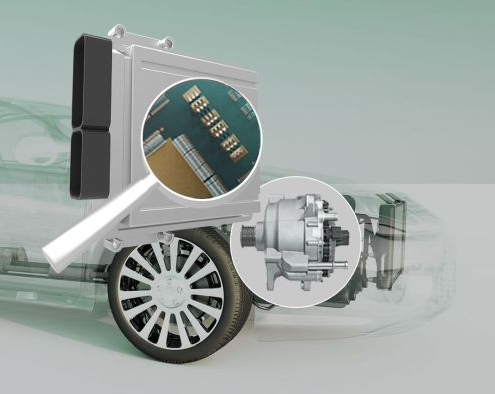
Automotive:
Electric Steering, Gear Box Control, Adaptive cruise control, LED Head Lights
Semiconductor Equipment:
Communication devices, Aerospace, Electronics industry
E-Mobility – Battery Packs:
Contacting BMS/BMB, Cell Interconnection, Voltage Sensing